
“It’s day to day. We have had to shut down factories. It’s hand-to-mouth right now.” Ford CEO Jim Farley said that on Bloomberg TV in June 2025, describing what a rare-earth shortage does to a car plant. Ford had idled its Chicago plant, which builds the Explorer, because it could not get the magnets.
The magnets come from China. Almost all of them.
The chokepoint is refining, not mining
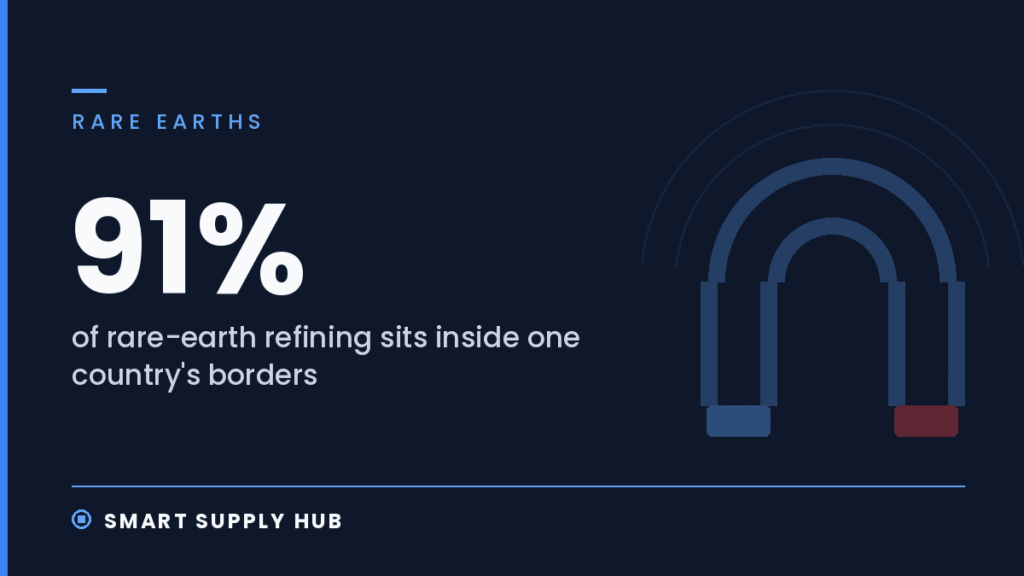
Rare earths are not geologically rare. The bottleneck is processing. The International Energy Agency put China at around 61% of mined rare-earth supply in 2024 but roughly 91% of refining. For the heavy rare earths that matter most to motors and defence — dysprosium, terbium — analysts at Sprott estimate China controls 98–99% of separated supply.
That concentration is a lever, and through 2025 and 2026 China pulled it repeatedly. Licensing controls on seven rare-earth elements arrived in April 2025. In October, five more were added, along with an extraterritorial rule reaching any product with more than 0.1% Chinese-origin rare-earth content by value. A US–China stand-down suspended the October measures until November 2026. Then, on 22 June 2026, China added ten US entities to its export-control list, among them MP Materials and USA Rare Earth — the two names most central to America’s plan to build supply outside China.
What the controls did to price
NdPr oxide — the feedstock for permanent magnets — opened 2026 near $53 a kilogram. By late April it had reached roughly $126–138. It then settled back toward $90 by June, still about 70% above where the year began. Terbium and dysprosium each more than doubled year-to-date before diverging.
S&P Global expects the strain to hold. In a January 2026 assessment it concluded the market outside China “will continue to face bottlenecks in the supply of heavy rare-earth products over 2026 and 2027” while alternative supply slowly ramps. Charles Altshuler, interim chief of Globe Metals & Mining, located the problem precisely: “The real pinch point is processing, refining and qualification.” Mining more ore does not help if there is nowhere outside China to separate it at scale.
How long a fix takes
Western supply is thin. MP Materials and Lynas together cover less than 15% of global NdPr demand. Building the rest is not a two-year project. Ryan Castilloux, founder of Adamas Intelligence, told Al Jazeera in October 2025 that even with “sustained policy and investment momentum,” the US and its allies “will likely need 10 to 15 years” to build a supply chain with the breadth and depth to meet demand.
The exposure runs wider than cars. Electric vehicles, wind turbines, defence systems, industrial robots, and the servers inside AI data centres all depend on rare-earth magnets. CSIS reported that China shipped the US just 17 tonnes of yttrium between April and December 2025, against 333 tonnes in the preceding eight months. That is what a controlled chokepoint looks like in a single number.
What buyers are doing about it
There is no clever procurement move that conjures supply China has withheld. The realistic responses are structural and slow: map rare-earth exposure two tiers deep, including Chinese-origin content caught by the 0.1% extraterritorial rule; qualify non-Chinese magnet sources early and accept they will cost more; sign long-term offtake with Western producers to fund the capacity that does not yet exist; and design magnet-lean or magnet-free alternatives where the engineering allows.
One date belongs in every affected company’s calendar. The suspension of China’s October 2025 controls lapses in November 2026. If it is not renewed, the tighter regime returns — and the scramble Farley described stops being a memory.