
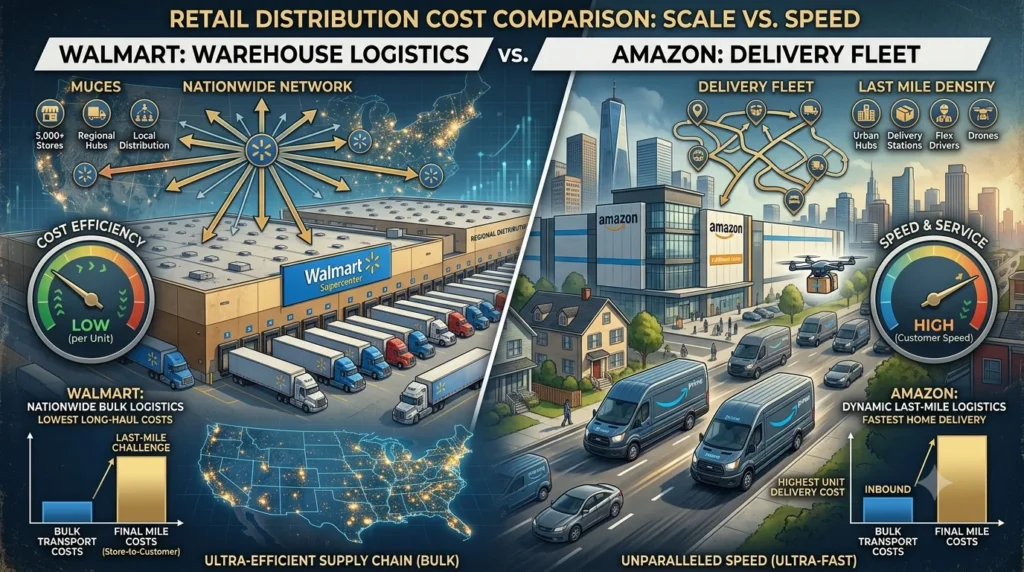
In 1989 Walmart was named Retailer of the Decade. Its distribution costs that year ran at about 1.7% of cost of sales. Kmart’s ran at 3.5%. Sears sat at 5%.
No shopper could see that gap. It decided the industry anyway.
Kmart filed for Chapter 11 on 22 January 2002, the largest retail bankruptcy in American history at the time, with 2,114 stores still open. Weeks earlier Forbes had described the problem in physical form: roughly 1,600 trailers parked behind Kmart stores, holding stock the buildings could not. The company was losing 4.5% of its inventory to damage and theft, nearly twice the industry average. Goods arrived because a central planner had pushed them, not because anyone had sold anything.
What the satellite network actually did
Walmart’s answer was information, and it bought the plumbing early.
By 1987 the company had completed a $24m Ku-band network — a dish on every store, a large antenna at Bentonville, two-way voice and data, one-way video. Contemporary accounts called it the largest private satellite communication system in the United States. Walmart launched no spacecraft and owned no orbit; it leased capacity and built ground stations. The advantage was never the hardware. It was that a barcode scanned at a checkout became a replenishment signal the same day, so trucks moved on demand rather than on a planner’s schedule.
What that data could eventually do showed up seventeen years later, on a different platform. A week before Hurricane Frances hit Florida in September 2004, Walmart’s chief information officer Linda Dillman pushed her team to build forecasts from what the chain had sold during Hurricane Charley weeks earlier. Strawberry Pop-Tarts, she told the New York Times that November, sold at “seven times their normal sales rate” before a hurricane. The top seller ahead of one was beer. Trucks carrying both went down Interstate 95 ahead of the storm.
Amazon inverted the metric
Walmart cross-docked cases. Amazon moves units, and rebuilt its network around that.
By March 2023 it had split the United States into eight interconnected regions and largely stopped shipping across the country. Writing in the INFORMS Journal on Applied Analytics, the team behind the change reported orders fulfilled within a customer’s own region rising from 62% to 76%, distance to customers down 15%, middle-mile touchpoints down 12%, and the first fall in cost-to-serve per unit since 2018 — better than $0.45 a unit in the US. “Regionalization is working,” Andy Jassy told analysts.
Speed followed. Amazon delivered more than 9 billion items same-day or next-day globally in 2024, up from 7 billion in 2023.
The technology now reaches the last few feet. Vision-Assisted Package Retrieval, announced in October 2024, projects a green circle onto the packages a driver needs at the current stop and a red X onto the rest. In early testing Amazon measured a 67% drop in drivers’ perceived physical and mental effort and more than 30 minutes saved per route. Bobby Garcia, a driver with contractor Bloomfield Logistics, said clearing a tote and sorting packages for the next stops used to take him two to five minutes; with VAPR it takes “about a minute.” It went into 1,000 Rivian vans — out of a fleet above 100,000.
The bill for speed
This is where the Walmart parallel breaks.
Amazon’s 2025 accounts show $109.1bn in fulfilment expense, up from $98.5bn, and $102.7bn in shipping costs, up from $95.8bn. That is $211.8bn to move goods, against $716.9bn of net sales. Walmart’s edge was spending a third of what Kmart spent. Amazon spends more than almost anyone and wins regardless, because it stopped buying cheap distribution and started buying time.
The scoreboard settled the argument in 2025. Pitney Bowes had Amazon Logistics at 6.3 billion parcels and 28% of US volume in 2024, second to the Postal Service, and projected it would take the lead by 2028. It got there three years early.
Math still picks the winner. The variable changed.
Sources
- Altimetry, “Walmart Pioneered ‘The Customer Is Always Right'” — 1987 satellite network, $24m cost
- EBSCO Research Starters, “Sam Walton” — Wal-Mart Satellite Network, largest private system in the US
- Research-Methodology.net, “Walmart Value Chain Analysis” — 1989 Retailer of the Decade; 1.7% / 3.5% / 5% distribution costs
- Forbes, “For Kmart, Bankruptcy May Be Best”, 3 January 2002 — ~1,600 trailers, 4.5% inventory shrinkage
- New York Times (Hays, 2004), reproduced via Yahoo Lifestyle, “Why Walmart Always Stocks Up On Strawberry Pop-Tarts Before a Hurricane” — Linda Dillman quote, Hurricane Frances
- INFORMS Journal on Applied Analytics, “Regionalize and Scale: Amazon’s Fulfillment Network Design” — March 2023 full deployment; 76% in-region; 9bn items in 2024
- Transport Topics, “Amazon Unveils AI Tool to Help Drivers Find Packages Faster” — 1,000-van rollout
- MarketScreener, “Amazon.com: Annual Report for Fiscal Year Ending December 31, 2025 (Form 10-K)” — shipping costs $102.7bn
- Capital One Shopping, “Amazon Logistics Statistics (2026)” — fulfilment expense $109.1bn; combined $211.8bn
- Pitney Bowes, “Parcel Shipping Index” — Amazon Logistics overtakes USPS, 6.9bn parcels
- Digital Commerce 360, “Amazon closing parcel delivery gap with USPS” — 2024 baseline, 28% / 6.3bn, original 2028 projection
- Supply Chain Dive, “Amazon overtakes USPS as top delivery provider by volume” — ShipMatrix, November 2025 crossover