
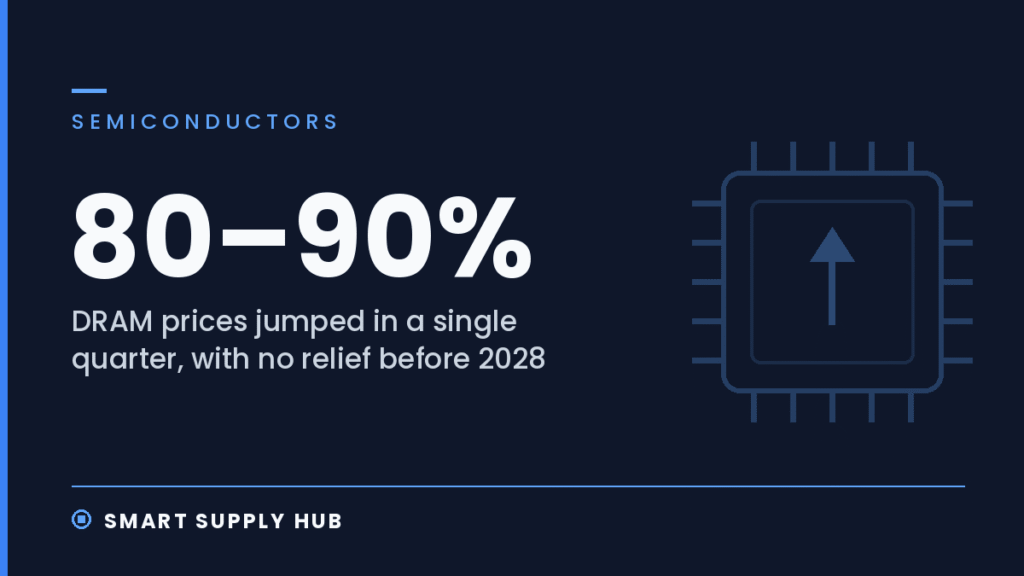
“This time really is different. It really is the craziest time ever.” Avril Wu has watched the memory chip market for roughly 20 years. She said that in early 2026, as conventional DRAM prices rose 80–90% in a single quarter, according to Counterpoint Research.
The cause is structural, and it does not clear before 2027–2028.
How HBM ate the DRAM market
High-bandwidth memory is the architecture inside AI accelerators. One HBM module eats roughly three times the wafer area of an equivalent DDR5 module, and sells for $60–100 against DDR5’s $5–10. Faced with that maths, Samsung, SK Hynix, and Micron all pivoted capacity toward HBM. It now swallows around 23% of total DRAM wafer capacity, and SK Hynix has booked its entire 2026 HBM output under contract, most of it to Nvidia.
That leaves everyone else fighting over what remains. IDC estimates data centres will consume roughly 70% of all memory produced worldwide in 2026, up from 20–30% in 2022 — a figure reported by the Wall Street Journal and Tom’s Hardware that January. It describes a permanent reallocation, not a spike that self-corrects.
The manufacturers agree on the timeline, which is unusual. SK Hynix CEO Kwak Noh-jung told Reuters on 10 July 2026 that “next year will be the worst year in the industry’s history from the supply perspective,” with demand outrunning supply “even beyond 2030.” Samsung’s memory chief Kim Jaejune warned in April 2026 of shortages through at least 2027. Nvidia’s Jensen Huang, announcing a multiyear SK Hynix deal in June, said the squeeze “is going to persist for quite a few years.” UBS expects undersupply until at least the second quarter of 2028.
What it costs outside the data centre
Consumer hardware felt it first. IDC trimmed its 2026 smartphone forecast by up to 5% and its PC forecast by up to 9% as costs passed through. Dell, HP, and Lenovo flagged 15–20% price rises. Apple lifted MacBook Pro prices by as much as $400. HP disclosed that memory now runs about 35% of a PC’s bill of materials — a component line that used to be a rounding error.
Automotive took longer, then took it hard. LPDDR4 for cars rose around 70% year-over-year by January 2026, per S&P Global, with lead times past 58 weeks. Elon Musk described hitting a “chip wall” late that January. When Samsung signalled end-of-life for DDR4, companies still built on legacy memory were forced into last-time-buy decisions they had never planned for.
One data point captures how far the market bent. Caramon, which reclaims RAM from decommissioned servers, watched monthly revenue roughly double, from $500,000 to $900,000, as buyers chased any supply at all.
What procurement can actually do
Spot buying in conventional DRAM is now a losing game. The workable moves are duller and earlier: place 12–24-month forecasts with manufacturers instead of buying spot, push purchase-order coverage out to 90–120 days, audit bills of materials for DDR4 and low-density DDR5 exposure, and qualify alternative architectures before allocation pressure forces a redesign on deadline.
Quote-validity windows have collapsed to days in some categories. A team that waits for a price to firm before raising the order will find the window already shut.
No relief is forecast before late 2027. Any plan resting on the DRAM market calming down in 2026 needs rewriting now.